
ICT delivery models for SMB ?
What are a business ICT needs ?

Defining cloud computing


Solution flavors
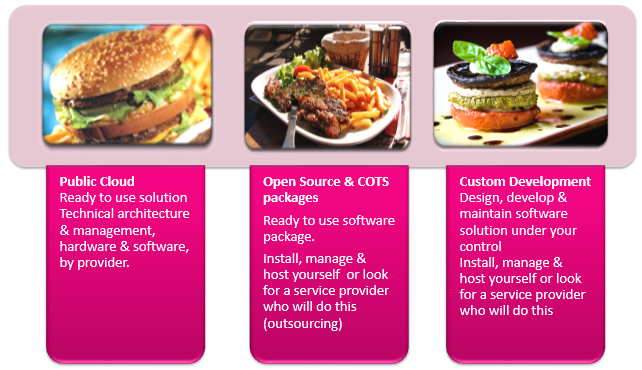
Public cloud

A BigMac (c) at McDonalds...
What ?
Pro
- quick in the air (subscribe, and there it is...)
- don’t require complex technical skills,
- don’t have to worry about buying, upgrading hardware & software
- Most are monitored and managed 24x7 (day and night, weekends included)
- Security patching and upgrades will be provided by the vendor
- The solution should not become outdated: new functionality and releases should come.
Contra
- It might be impossible to integrate tightly with the backend processes in your company. For example, you have an existing warehouse solution, and want to integrate with that one. Public cloud solutions are by definition very “plain vanilla”. It’s a standard hamburger you get served... You can’t ask Mc-Donalds to serve you a modified version of its hamburger: you take a cheeseburger or a big Mac, or go elsewhere...
- The recipe for the hamburger is secret and the property of Mc-Donalds: so is also your business automation – you will not be the owner of the code supporting it, so if this service provider goes bust, you might be in a lot of trouble to recover your work and get it in the air somewhere else.
- Where is your data ? Cloudproviders will not be transparant about where in the world your data will be - where their datacenters are located. If outside the EU, you might have a legal issue... (e.g. do we trust foreign goverments not to access our data ?)
Undecided: pricing
- number of functional modules used
- number of users
- storage capacity
- traffic volume
- number of transactions,
- number of products,
- etc...
Private cloud, and using open source or COTS ?

The Bistro
If the standard hamburger is not acceptable – you want more variation and some possibility to interact with the chef for example because you have special dietary requirements or have some gastronomic wishes, But your budget is still rather tight, and you want to eat this evening, not within a couple of months. The Belgian classic “Steak Frites” is the one you long for – but serviced with pickles, not with mayonnaise as is the standard.. Then popping in at a Bistro (*) might be the thing to do as you definitely don’t want to cook yourself. And if you didn’t like the meal, you might just decide to go to another bistro the next time also having “steak frites” on the menu – this really should not be a problem, “steak frites” is such a classic...
(*) a Bistro offers a limited set of reasonably quality meals at competitive prices. It’s really a good compromise when a restaurant is too expensive and requires reservation.
How ?
Translated to you ICT needs: you want an ICT business automation solution at a competitive price. You are willing to start from a standard product offering, but some tuning, adaptation and integration work must be possible. If you don’t like the service provider anymore, you would love to be in a situation where it is possible to have to same product provided from a different supplier.
What: look at open source & COTS
Wat is the software suite you should run ? Check if for the business automation problem you have quality open source packages do exist. In this case, you get the software from the “community” for free. You might need a paid service contract for support though.
If you can’t find an open source package with the right quality and functionality, you can still go for a well known COTS (Commercial Of-The-Shelve) Software package. In a business automation world, SAP would be the typical example.
Where to run it - consider private cloud
As you don’t want to cook yourself, you need to outsource or outttask the work. Public cloud will not do, as those solutions are typically shared between the customers of the provider and can’t be adapted (much). Private cloud might provide an option: Here the application is running on dedicated systems, as a dedicated instance for this customer, in a datacenter where you know the location. An ICT team of a vendor will provide monitoring and system administration functions. As you are running dedicated, specific integration and adaptation is a possibility.
DIY instead of private cloud ?
If you want to cook yourself simple bistro meals, you can still opt not to go for private cloud: You will need to provision yourself the server infrastructure and the technical management and monitoring of it. If you are an SMB, it’s unlikely your company has the skillset to do this in professional way to create a perfect dinner.
Pro
Going for an Open Source solution or COTS, and there are quite some around, gives you the quick start. You might need this speed in this competitive world. As you have access to the code in the case of Open Source, building integration gateways with other components in your environment can typically be done. Also modifications are not an issue, given you find the resources with the right skills for this open source package. COTS software will typically have integration gateways.
New features and functionality should come from the community in case of open source of from the vendor in case of COTS.
In case of Open Source, you really own the application and have the source code of extra development. So you will suffer less if somebody goes bust...
Contra
You will have to look for a solution to host the package. You can host in your own datacenter, if you have one, or rent server capacity from a datacenter service provider. You might be lucky and get this delivered outsourced, in e.g. a private cloud solution. If you are in the SMB space, you probably don’t have the ICT resources for a 24x7 management – so private cloud, outsourcing & outtasking are really the way to go to limit those negative aspects
New versions and security patching do come, but you might have costs: you will have to give workorders for the new version to be installed and deployed. In case of COTS, you might need to purchase this new version.
A disadvantage from using an Open Source package or a COTS (Commercial of the shelve software) is that you can not force the community to add in the release the functionality you need – you can only asks and argument...
Custom solution

If you really have high culinary wishes, only a 2 star Michelin restaurant will do. The meals will be unique – no other restaurant will offer exactly the same recipe, so if the restaurant closes down, you will be in trouble to find another one being able to prepare your favorite meal. It will be very expensive. You will have to reserve a long time upfront. But it will be delicious (you hope). You might even invite the chef at your home to do the cooking there.
Be careful !
It’s old school to do this: going for a “Custom Solution”. In this case a solution is developed really tuned towards your needs. It could be that such a solution uses a core of open source or COTS package, but you are deviating so much from the standard release that it becomes a custom solution.
Even worst, you could start from scratch your coding. In such a scenario, you need to identify the resources needed for designing, implementing, operating and maintaining the software architecture. This will take a long time! Can you afford to wait so long for automation? Your competitors are accelerating! You might be on your own now, as your solution is so unique.
Don't’ expect improvements from the vendor in case of COTS or the community in case of Open Source to come to you: You have been modifying the solution so much its has become expensive or even impossible to move on to the next release of the parent product.
In current competitive world, you really can’t afford as an SMB to do this, except if you have very very good reasons to do something unique. It’s not a good reason to state your business processes are different from a popular open source or COTS package: It’s way cheaper to adapt your way of working to an industry standard way of doing things then to adapt the software.
Final conclusion
So in our budget conscious model, try to find a private cloud offering of an open source package.This scenario is nowadays almost standard for business ICT needs such as a webshop (e.g. “Magento” as open source starter) or CMS (Content Management System, an easy to maintain website creation environment) (Joomla, Drupal,...) It is not yet the standard for enterprise suites. But times are changing. We will have a look today at an open source business suite which is available in public and private cloud and also be installed at your business premissed in case you want to cook yourself